
Home • Free Resources • The Habit Loop for Traders
The Habit Loop for Traders
Cue, routine, reward, why disciplined trading rules break down under repetition, and how to rebuild them.
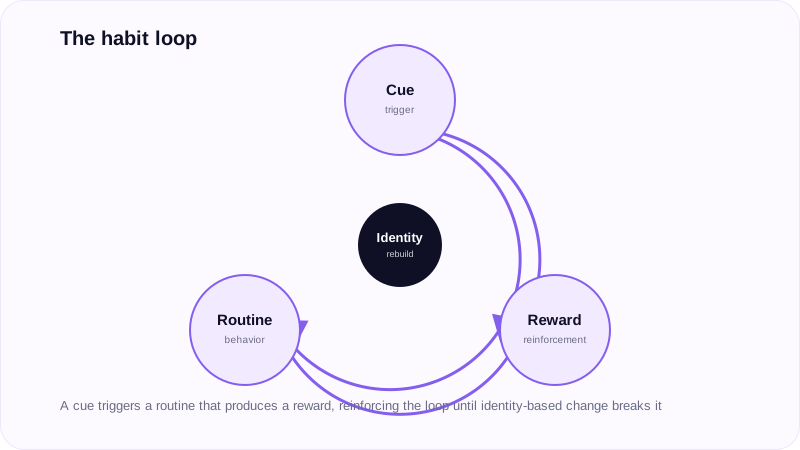
Trading discipline is a habits problem before it is a strategy problem. The habit loop framework, cue, routine, reward, combined with identity-based habit change, explains why disciplined trading rules break down under repetition and how to rebuild them so they hold.
Bad habits have a structure
Overtrading, misplaced or skipped stop losses, losing patience, and taking trades on pattern recognition alone without higher-timeframe context are routines driven by a cue and a reward, usually one the trader isn't consciously aware of. A habit cannot be changed until it is understood.
The four-step framework
- 1.Identify the routine. Describe the behavior in detail, for example, logging into the account, a quick chart glance, then sometimes overtrading into an account blowup.
- 2.Experiment with rewards. The real reward is often not the trade itself but the underlying craving, money, excitement, distraction, or a small-win feeling. Testing different rewards over several days isolates what is actually being sought.
- 3.Isolate the cue. Cues fall into five categories, location, time, emotional state, other people, and the immediately preceding action. Tracking these around the bad behavior for a few days surfaces the actual trigger, for example, boredom, being alone, sitting at a desk, right after watching a trading video.
- 4.Build a plan. Once the cue, craving, and reward are known, deliberately substitute a new routine that satisfies the same underlying craving while anticipating the cue rather than reacting to it.
Four laws of behavior change
The same four laws apply in both directions, building a good trading habit or breaking a bad one.
| Law | Build a good habit | Break a bad habit |
|---|---|---|
| Cue | Make it obvious | Make it invisible |
| Craving | Make it attractive | Make it unattractive |
| Response | Make it easy | Make it difficult |
| Reward | Make it satisfying | Make it unsatisfying |
Supporting principles
Identity drives process, and process drives outcomes, in that order. "Consistently disciplined trader" is an identity; habits are the evidence of that identity, and outcomes follow from the process rather than the other way around. Small, consistent improvement compounds, roughly 1% better each day compounds to about 37 times better over a year, which reframes trading improvement as a systems problem rather than a single defining-moment fix. Habit stacking, "after I [current habit], I will [new habit]", anchors a new discipline to something already done daily, such as writing a bias and plan immediately after opening the trading platform, before looking for entries. Missing a habit once is normal; missing it twice starts a new, worse pattern, consistency matters more than perfection.
Illustrative example
Consider a trader with five years of experience who blows up an account roughly every third month through overtrading and impulsive trades. Applying the framework, identify the routine (chart glance leading to occasional overtrading), experiment to find the true craving (money, intensity, or distraction), isolate the cue (boredom, being alone, at the desk, right after watching a video), then build a plan, substituting a pre-market ritual that delivers the same craving without the destructive trade.
Key takeaways
- Bad trading habits are routines driven by an identifiable cue and reward, not random lapses.
- Work the loop in order, identify the routine, find the real reward, isolate the cue, then build a substitute plan.
- Apply the four laws, obvious/attractive/easy/satisfying, to build good habits, and their inverse to break bad ones.
- Anchor identity to process, act like the trader you want to become, and let outcomes follow.
- Small, consistent 1%-per-day improvement compounds far more than a single big change.